








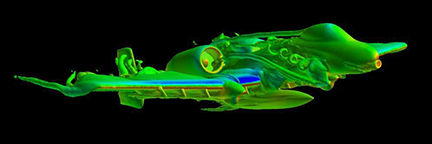
A-10C aircraft with 600 gallon fuel tank at Mach 0.3 wind tunnel test, with current CFD data added in
Red curve: clean configuration
Teal curve: 3 tank configuration
Blue curve: extended the available data to the necessary sideslip values being tested today
"HPCMP Capabilities facilitate discovery of undesired flight characteristics during an aircraft’s design phase; reducing time required for design and testing." —James Clifton, Air Force SEEK EAGLE Office.
HPCMP resources enabled:
- Rapid development testing – reducing capability development time by several months
- Advanced development of computational approach for accurately determining aircraft response to pilot input or “virtual flight testing”
- Quick turn-around time on decision making data. Reduced flight test risk and confirmed safety of flight parameter boundaries
Read the full paper – Stability and Control Test and Evaluation Process Improvements through Judicious Use of HPC Simulations (3348) [PDF Version]
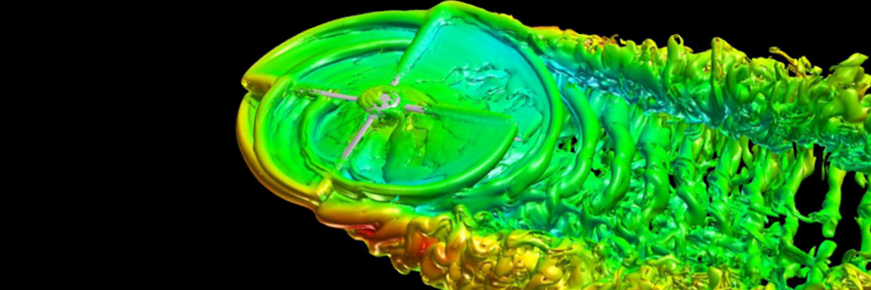
Helios visualization of rotor vortices
Increasing helicopter hover thrust performance normally trades-off with forward-flight performance. Army AMRDEC/AED and Boeing used HPCMP CREATETM-AV Helios software and three million CPU-hours on DSRC supercomputing hardware to confirm Boeing’s predictions of improved and isolated rotor performance and then, for the first time, verified computationally the integrated rotor/rotor and rotor/fuselage interactional aerodynamics and installed performance of the new rotors.
HPCMP CREATETM Helios Software and HPCMP computer resources enabled:
- Virtual testing of the integrated CH-47F with new rotor via high fidelity analysis early in the design process, including aft pylon height and blade indexing.
- Flight test planning in advance of scheduled test events.
HPCMP CREATETM software and expertise and HPCMP computer resources enabled early design stage predictions of helicopter performance that project up to an estimated 2,000 pounds improved hover thrust for 400+ Chinooks, without significant impact of forward-flight performance. This added lift capacity translates into nearly 5,000 more M-16 rounds, days of food and water, or more troops on each flight.
If confirmed with flight tests early in 2015, the new rotor blade will enable approximately 400 modified CH-47Fs to deliver more troops and equipment with each flight, without increased risk in hostile and demanding environments.
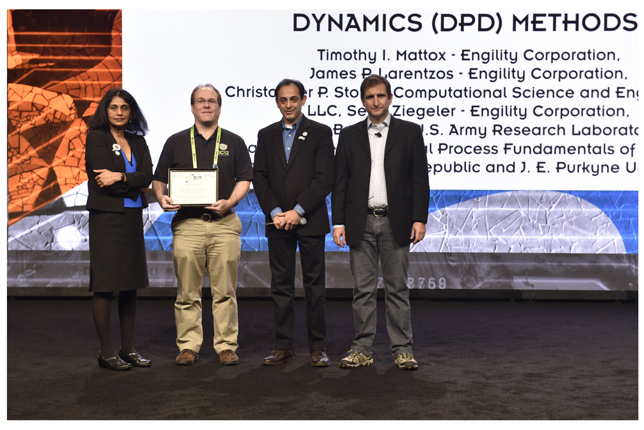
Congratulations to the HPCMP PETTT team (Dr. Timothy Mattox, Dr. James Larentzos, Dr. Sean Ziegeler, (DoD High Performance Computing Modernization Program); Dr. Christopher Stone (Computational Science & Engineering, LLC); Dr. John Brennan (U.S. Army Research Laboratory); and Dr. Martin Lísal (Institute of Chemical Process Fundamentals, J.E. Purkinje University), whose poster, “Parallelization, Acceleration, and Advancement of Dissipative Particle Dynamics (DPD) Methods,” won the Best Poster award at the International Conference for High Performance Computing, Networking, Storage and Analysis 2015 (SC15). Each year, the SC Computing Posters Committee identifies one poster as the best poster to be presented as part of the Conference’s Technical Program. The award was announced at the SC15 awards ceremony in Austin, TX, on November 19.
Look for the technical article in the upcoming issue of HPC Insights.
Additional Software Defined Networking (SDN) websites are categorized as:
General Information
Recent News
Resources for Deployment and Testing
General Information
Here are some websites providing general information about Software-Defined Networking (SDN) and associated software architectures:
Recent News
Here are some blogs and websites providing recent news about SDN and associated software architectures:
- ComputerWeekly.com
- InfoQ
- Layer123
- LightReading
- Networkworld
- SDXCentral (Cloud Articles, Whitepapers, Videos, & more)
Resources for Deployment and Testing
Here are some websites providing resources for deployment and testing of SDN or associated software architectures:
- GitHub
- Global Environment for Networking Innovation (GENI) wiki
- IETF Request for Comments (RFCs) (searching for “software defined”)
- KeepingITClassless (searching for “SDN”)
- SDN Lab
Return to the SDN FAQ page.